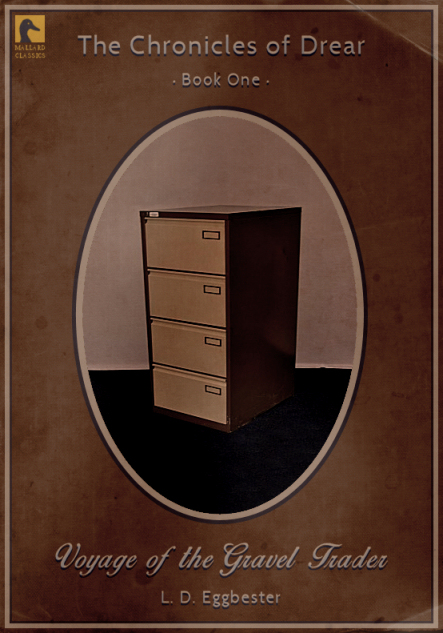
Today in Nostalgia Corner we look at Voyage of the Gravel Trader, the first book in the well-known Chronicles of Drear series. Like many, I grew up with these novels just lying around; originally owned by my elder sister, they were passed – by way of my two brothers – down to me. The lasting memory I have of this book is one of sitting halfway up the stairs in my parents’ house, locating my place before carefully resolving the folded page corner, then being swept up and away to another place for hours at a time before eventually touching down once again in a world which seemed newly brighter. The image above is a scan of the late 80’s paperback I found under a bush in 2004, as sadly my original 1955 edition could not be salvaged after passing briefly through Scamp, who was both the Brown family dog and the brown family dog.
I like to think that the greatest stories come to you as broken things, requiring the reader to pause periodically and use their wits to, as it were, experimentally push the bits around until the devices mesh their teeth and spring into whirring life. At the end of such novels, it’s almost as if you’re standing side-by-side with the author at a workbench, knuckles pleasantly grazed and wiping grease from your fingertips as they polish their glasses. You shake hands, nod your respects and go your separate ways. Voyage of the Gravel Trader however, is not such a book. Its author, Lawrence Damocles Eggbester, is in fact mercilessly straightforward in his storytelling, allowing no room whatsoever for subtextual interpretation and showing next to no courtesy to the reader’s imagination. Indeed, upon the release of the recent movie tie-in edition, Matthew Pounder of The Ardent on Sunday remarked, “Only the most dismal of masochists would subject themselves to this toss…Eggbester’s works, though unquestionably impressive in terms of sheer world-building scope, nevertheless read like a Haynes manual.” It is an unavoidable truth: Eggbester’s themes, scenes and characters have all the emotional warmth and humanity of the Drearian Quarrylands which he so anally describes over twenty-eight punishing pages. This rare talent makes him a truly unique author, and for that I salute him.
The story, being the first of the thirty-four-book chronicles, sets the stage for the entire series by relating the beginning of all the comings and goings between the worlds that would follow. It concerns mainly the three popular but thick Brellend children: Georgina, Jeremy and Andrew who are whisked away from wartime Sussex by means of a mysterious beige filing cabinet and deposited in the workaday land of Drear. Once there, they are tasked by the ancient Boardking Clive – as he sits dying on his thronechair – with bringing an end to the epic and bitter trade negotiations which have for centuries blighted a realm whose economy is almost entirely dependant upon its principal export: gravel and gravel-like aggregates. Despite their protestations they are press ganged aboard the mighty cargo vessel The Gravel Trader bound for international waters, where they spend several months heroically petitioning and placating representatives of the surrounding nations in the hope that they may lift their cruel embargoes, thereby allowing Drear and its people to once again enjoy relative economic stability. The children are assisted in this strange new world by their guide Mr. Nicholas – a half man, half man normal man with no quirks and few distinguishing features. Over the course of their long, long adventure they learn the true value and inherent nobility of things like bribery, brown-nosing, manipulation and under-the-table dealing.
Below is a short extract from the book, and one of my favourite passages. It is reproduced here with the kind permission of Susan Eggbester and Mallard Publishing. I have taken something of a liberty by omitting the large sections of material which deal primarily with descriptions of the surroundings, as these accounted for the vast majority of the chapter and would be far too unwieldy in this format. I would also like to add that this book is very much of its time and as such describes attitudes to gender which are, to modern eyes, quite unacceptable. I have left these parts of the text intact for posterity.
Chapter 7
In the Hall of the Boardking
As they were bustled through the tall, polished, mahogany doors, Georgina eyed the back of the leading guardclerk’s shining silver waistcoat with interest. I should like a gown of that fabric, she thought to herself, as she was just a silly girl with a head full of dresses and gay songs. To either side of her, her brothers strode manfully in the fashion of their father but their faces betrayed them with shadows of nervousness. Andrew turned sharply to the retreating guardclerk who had been flanking him and spoke hotly, pushing his chest out ever further. ‘Now see here! I demand-‘
‘Demand?’ A voice cut him dead, thin but made grand by the echoing expanse of the hall. ‘What is it you demand, boy?’ Their guards silently brought the doors together behind them and their footsteps died away, a solemn tattoo in the then aching quiet. The children looked about themselves in a confused moment before finding the voice’s owner seated in an enormous, imposing chair silhouetted against the vast window that made up a good deal of the furthest wall.
‘Well, I…’ began Andrew again, though this time uncertainty and the magnificence of his surroundings cooled his tone. ‘That is, I mean…’ He lapsed into silence. Jeremy gave him an encouraging glance, but to no result.
‘Hmm,’ said the voice. ‘I expect you merely wish to ask why it is you have been bought here, yes?’ The voice came softer now. Kinder, or perhaps simply more weary. ‘Do come closer so I can look at you, my eyes are not what they once were.’
It was Georgina who stepped first, as she had less worry of the situation, being just a silly girl with a head full of flowers and kittens. Always protective of their sister, the boys quickly overtook her and presently they were all three of them standing before the largest desk any of them had ever seen. It was as wide as a barge and of the same rich, dark wood as the doors. The man behind it regarded them wordlessly, looking from one to the next as if studying dogs for ticks. He appeared elderly and frail and sharp and keen all at once.
Months before, during the summer holidays Jeremy had been digging for worms in the herb garden and found what turned out to be a very old bone needle. He had held it up to the sun, turning it this way and that, and was taken by its near-translucent quality. The man before them, with the curve of his nose and pale, pale skin put in him mind of that fine, delicate prize. Andrew was transfixed only by this stranger’s gaze; there was something in it – some urging thing which made one want to be found good, productive. He’d seen its like before in a magazine from the front lines, on some general or other, highly decorated. Do well, it said. I want you to do well. Andrew felt a small part of himself deep, deep down answer involuntarily: Yes. I will do well. Georgina thought he looked stern like her headmaster but did think his tie was a pretty colour.
Apparently satisfied, the man behind the mammoth desk snapped his eyes down to one of a number of yellow paper sheets arrayed before him. ‘Now, it says here…’ he intoned, ‘yes, it says you all arrived via the File Cabinet. Is that correct?’
Both Andrew and Georgina nodded and uttered that yes, they had indeed come by that strange piece of office furniture, but Jeremy could never long contain his curiosity and it bubbled to the surface as he blurted out, ‘I say, it must be some jolly queer magic of yours to have fetched us here all the way from England!’ He thought for a moment as he looked from the man to his siblings, then added, ‘Wherever here is.’
‘Magic!’ exclaimed the man. ‘My dear child, there is no magic in this world nor any other. Your manner of travel was nothing more than hard science – logistical matter facsimile technology we used in days gone by, before the shipping unions got their way. The File Cabinet simply made an account of your component parts then destroyed the originals after creating duplicates here. Here being Drear, of course.’
‘Drear,’ echoed Jeremy and Andrew hollowly. Georgina however, though she was just a silly girl with a head full of ponies and dolls, had heard something which did not altogether please her. ‘Destroyed?’ she murmured.
The man winked at her. ‘Oh yes. Smashed to atoms in the blink of an eye. PAFF!’ He spread his slender fingers in the air and waved them to illustrate his point.
‘So you mean to say we’re… dead?‘ quavered Georgina, peering down at her small hands and beginning to sob as she looked, mystified, from one palm to the other.
‘No no no, not dead as such,’ said the man hastily. ‘These new bodies you have are just as good as those you had in England, and you’re still you, are you not?’
‘I… I think so. I don’t know,’ she replied in a tiny voice, moving to hug herself to Jeremy who did not look completely well but held her close regardless, shaking ever so slightly as he did so.
‘There’s a good girl. Now, before I forget, you must take these,’ said the man, removing three thick, blue document folders from a drawer to his left and placing one in front of each of the children. ‘While it is true you are still, legally speaking, you, it is also the case that you are physically made of Drearian material. This means you are regretfully, but technically, the property of the Drearian State. Do not concern yourselves overly with this, it is merely a formality and almost never an issue. Though if you wish to query or appeal against our ownership you need only fill out these forms in triplicate and return them, in person, to our any of our legalknights.’
All this suddenly became too much to bear for Andrew, and once again the colour rose in his cheeks as he declared, ‘This sounds entirely like a very rum business indeed, and I for one don’t like it one bit! Our father will hear of this, you mark my words, and I think it’s only right to tell you that our family has the services of the finest legal minds in the British Empire!’
‘Ah,’ nodded the man gravely while glancing at his sheets, ‘Andrew. I’m afraid the lawyers you speak of have no sway here, and in any case, they would make poor sport for the Drearian legalknight battalions. If you doubt this then please do look out from my window upon the Great Car Park.’
Andrew snorted petulantly as he loped over to the indicated pane and, after a moment, gasped at what he beheld. A Great Car Park indeed. An oblong courtyard with three walled sides stretching what must have been a clear mile toward the grey horizon, and upon every square foot of it stood stiffly a legalknight. Rank after rank, row after row, thousand after thousand they stood; their burnished bronze briefcases gleaming in what little sunlight slunk through the cloud-thick skies. ‘They’re… impressive,’ he admitted, unable to keep the awe from his throat.
‘Yes, they are. Impressive one and all,’ sighed the man, his apparent weariness returning, ‘but not a man among them is able to save us. We need something they do not possess – something no Drearian possesses.’
A gloom had crept into the hall then, a pervading sense of glory lost. The children shuffled uncomfortably as their host’s attention seemed to wander away. ‘Well. This won’t do,’ said the man, the Boardking abruptly, clapping his aged palms together and dispelling the bad air. ‘Let us talk of hope and brighter things. Tell me children, what know you of gravel?’
About the Author
Lawrence Damocles Eggbester (1917-1988) was born into a middle-class family in Brighton, England. He was educated at the St Dingus School for Boys and latterly Townton University where he studied bookkeeping and geology. At the age of twenty-three, having narrowly avoided conscription due to an acutely gammy forehead, Eggbester went to work as a file clerk for Dunworthy Aggregates, Dover – a post he held for the majority of his working life. It was there he first met his wife, Georgina. Prior to the Drear series of books he wrote three non-fiction titles in his spare time: Gravel: A Treatise, Gravel: A Deeper Understanding and the much more lighthearted Gravel Games for Rational Youths.
There are several unsubstantiated claims regarding Eggbester’s inspiration for The Chronicles of Drear. The most widely-spread of which is that one cold day in December 1954, after a morning spent staring blankly at the hundreds of files crowding his desk, he suffered some sort of colossal breakdown and ran yelping from the company’s offices. Some sources claim he was found by police later that week in a local library – unshaven, dishevelled and hurriedly shoving copies of C.S. Lewis’ recently published Narnia series down the front of his trousers. This sequence of events has been vehemently denied by family members who uniformly describe him as being “a quiet, sober man and a pillar of the community.”
Stay dangerous,
OXO
 Adequate Brown