0

Greased Pig Chase


Hurly piglets, burly boys & girls churn up.

Make worldly raw disorder

with assaults on sense after senses fail,

slick as heels & waists in soily mud.

Nothing is still so move, run too.


Turn in the June heat & straw.


I once asked my glancing father,

why this done thing is.

Grunt & huff were duly issued.

A fey gesture to grandfather tilted.

Rites bent brows, made furtive staggers.


I was given, to understand.


He spilled by slipped mask & disc,

by rote mache performance,

all he knew alone:

This, the least peculiarity

of fathomlessly strange futures,


is only a moment to grit teeth.


Stay nimble,

OXO

0

Nostalgia Corner – How Alan Moore Can Win You the Leeker Cup


I am fifteen and five months.

I behave savagely.

But.


I’m so fucking fast. I’m using that word more and more now. My overbite hates shitty ethsses but loves to fuck. I skate boredly over the ruins of pre-adultic disappointment with Ben.

Our shoes are fucked.

Fucking Miss Davies thinks I’m copying stories out of some book and making up words.

I am.

The last.

In class,

we say a language is ours, yet we must not pry open the gaps in its case? We must not write on the rom? What flavour of batthit is that?

Do you want an apple?

Asks Ben.

Not right now. Probably never.

I return over stranger cars.

Over our good trucks.

We wrap and wound gravity.

I go along well mostly. My kickflips are neat enough. Very fine lands echo from the schoolfront wall.

Radical Haha!

Ben is with me where it matters. Just as good as me, bitten just as bad.

My honest friend leaves and I meander home happily.

Delightedly.

Welsh hillily.

Because I do like to go fast.

When it’s only my elbows, knees and chin.

Hell met absense.

No padding worn thin.

I go as fast as I can carrying as much as it makes sense to take along. Madness to risky trick at speed and weighted. Anything but simple elegance is concrete, arsephelt damage. Right now I cut a silouette of a fat chaffinch on a quick grippy stick; pack_laden with two long wheels, yawning with vangled struts twice through. A dismantled ideal of square stability that, if it sneezed no spring, could quite well count in me winning:


THE 1995 CAERWEDROS, LLWYNDAFYDD & NANTERNIS

LEEKER SOAP-BOX CUP

Sponsored by Leeker

You’ll be right back after you take a Leeker!”

August 8th, Caerwedros Hall Field

Ages 9 – 16

“RECORD TURNOUT LAST YEAR!!!”

Cawl provided


Where I’m from, people are crazy. Mad as they come in hysterics. Leeker was an especially soft drink stocked and hocked exclusively in Ceredigion.


O Ceredigion.

Cold wet slab.

Of deepest.

Darkest.

Cymru.

You carbonated the leek,

bright bachgen, diolch!

Trad


It’ll make your dick piss your cock off, this stuff, boyss.

The headmistriss,

Miss Côt-Siaced,

would say.

Her blunt chin,

awash with it.

Her husband ran,

whenever he could.

The Small Shop.

Sold it.

You would not believe the taste of it.

It is like drinking love itself.

Love Distilled.

Desire consumable.

Home.

Everyone knew.

Such terrible effects.

And they laughed.

Through the bouts.

And the family rot.

It came unbidden to all in pint milk bottles, unwashably yoghurt-acted films given free. Crisper projections developed on each reuse and decycle. Their thin plays gave glassy comfort as we left out the empties in molded green-beige calamities of ancient life.

Heavenly.

It would kill you all friendly.

All your life. And did.

Ceredigion was lawless.

Healthy boarderless,

and hid.


You could forget yourself in the ringed around layers of the liquid leek.

Forget you meant to be present.

Now,

I intend to win this box-car race, carrying as I am always this pack laden with two long wheels, yawning with vangled struts twice through twice. Additional stifled springs, good bearings found, lost, found. Heavy metal skating. Waiting.

I have visited the small library in Abreraeron. Read that they once made the best longbows from yew. Fine lengths of it whip along with me in the wind. I collect it all.

I need one axle.

To turn an anchor into water.

I have this diagram, you see,

with an empty line.


I am forty and eight months.

I behave well.

Hid.


So. I am so I suppose.

Safe so sub-city.

Stitching.

Smiling sounds.

Sewing stowing sowing.

Store’en shuring storing.

Storie Space Esploring.

Softly softly thwearing.

Still

,

no axle to bare me.

Everywhere with jagged metals;

a cumbersome diagonal mirror ribcage,

is never ever absent.

The worst imaginable derigible thought,

of a wish to go faster

.

After several none evenings,

comes:

One evening.

A recorded awarded wizard.

Speaks through speaker.

I,

the listener, crane.

He tells me:


Take one piece of paper the length you need.

Write on it anywhere:

“Axle”

Coil.

It’s.

Edge.

Then.

Twist it until you can’t.

Wring into it past-wood past-tree past-seed.


I do as softly ordered;

twisting until I can’t.

Until the paper thins from sight.

Looking now I find it there.

Quick-cooling warm.

An empty line.


New in new hands.


Stay fuck,

OXO


0

An Apology / Retraction / Welcome Back

“I like to think that the greatest stories come to you as broken things, requiring the reader to pause periodically and use their wits to, as it were, experimentally push the bits around until the devices mesh their teeth and spring into whirring life. At the end of such novels, it’s almost as if you’re standing side-by-side with the author at a workbench, knuckles pleasantly grazed and wiping grease from your fingertips as they polish their glasses.” – Lawrence Damocles Eggbester

Mr Eggbester there, at his best. I wonder if he had even the faintest idea of the eventual weight of those words as he patted his back so hard. “Wait,” you say, “that wasn’t him. It was you!”  You’re right of course, but wrong. Put on a hat. Turn backwards. There. The difference is as short and thin as the very now. Cross your eyes. Lose and regain focus. Now we’re the same. After years, I declare my love for him and thus change his name by marriage. Lose that dangerous middle. Stand clear then carve through the single horse hair it depends from so, as it finally falls, its hungry edge cracks only the lonely ‘b’ down the stroke and slaps the remaining crescent over to make the most wonderful ‘n’.

Better. Much, much better; but my man Lawrence is a criminal. A liar. And our shared pen will not do our good bidding unless we first unwrite this:

“My dear child, there is no magic in this world nor any other.”

A joke was intended, clearly. And a tongue should have stayed at home in its cheek. Now, mechanically speaking, a joke must land on a truth or else it’s little more than time wasted on a lie. We’ve talked it right through, Lawrence and I, so here (for it must be here), now and on the same lit-up paper:

We sincerely, sincerely apologise.

There is magic in this world and every other. We’ve been presented with it gleaming golden, yet we cannot show it to you. To you it would not appear. You’d see only the thin air. If you had the right bright eyes and had perhaps just put down a perfect novel, you might see something akin to a trespassing breath between purpled iron bars. But eyes like that are not merely one in a million, or even a billion. They are only one. Our magic can only be seen by us. Yours will appear differently.

For one last time Lawrence and I will momentarily divide so he can have his last word:

You will know it when you see it.”

“And… I feel I should add,

that I did actually write:

‘The man winked at her.'”


Stay watchful,

OXO


2

A Look Ahead – Next Week’s TV Picks

TV

Celebrity Horse Knockout – BBC Choice Monday, 20.00pm

New! Action-rammed family entertainment show co-hosted by hardman Grant Mitchell and Richard “The Vole” Hammond. A wide spectrum of the celebrity ranks reprise their most significant punchy roles as they compete to deliver a devastating knockdown blow to an anatomically accurate recreation of a horse’s head. This week: Brad Pitt from Snatch, Clyde the orangutan from Every Which Way but Loose, the hand puppet Mr Punch, Uma Thurman from Kill Bill II and Sylvester Stallone from Antz.
Highlights: Richard “The Shrew” Hammond gawping like a wide-eyed dullard child as some ashamed boffins show him how they’ve 3D printed a horse skull and covered it in ballistics gel.
Playful, tightly-scripted banter as Richard “The Plague-Rat” Hammond ribs hardman Grant Mitchell about EastEnders then simpers timidly as hardman Grant Mitchell uses his compelling acting chops to loom over him like a threatening pantomime villain.
Lowlights: During an interview segment, a pixelated ex-streetfighter and thug breaks down into tears as he relates to hardman Grant Mitchell the grim story of how his childhood of deprivation and domestic abuse led him to a lifetime of violence. The cameraman pans hesitantly away throughout, seemingly unsure if this is okay. Richard “The Despicable Vermin” Hammond puts his finger on his chin and makes a serious face.

David Cronenberg’s Red Dwarf – Channel 5 Wednesday, 22.00pm

Chillingly masterful reworking of the cult TV phenomenon. Not a trace of the original’s far-out, zany humour remains in this, Cronenberg’s most psychologically scarring offering to date. Dave Lister – played by Golden Globe winner Joaquin Phoenix – endlessly roams the labyrinthine decks of an immense, cold space vessel, alternately weeping and laughing at the abject horror of his being the last example of a long-extinct humankind. His only crewmates are Academy Award winner Adrien Brody’s Rimmer – the hologram of a dead crewman driven to madness and obsessive compulsion by the body-shock of his resurrection, and a cat which merely serves to underscore his loneliness by its fear of him. Irresistible, if uncomfortable viewing.
Highlights: The protracted end scene of this episode sees Lister drunk and howling like a hurt animal as he barrels and tumbles brokenly down a dark service tunnel in pursuit of the cat. As it draws to a close, his tears and plaintive cries of love and assurance are interspersed with fast cuts to the cornered creature’s huge, terrified eyes filling the frame.
Lowlights: No Holly.

So You Think You Can Bellow? – ITV1 Thursday, 20.30pm

The votes are in! Britain’s perpetually tiresome communities have irreversibly nominated the most vocal of their denizens to join Brian Blessed for eight eardrum-destroying weeks in the specially-constructed Shoutodrome. Who’ll be staying? Who’ll be going home a shuddering husk?
Highlights: Blessed’s baffling, blasphemous, obscenity-strewn ‘Finishing Moves’ are an absolute joy to the ears. Also, the programme in its entirety is just as loud as the advert breaks, so you won’t be reaching for that remote every fifteen minutes.
Lowlights: Due to the nature of the contestants, there’s a dire lack of sad back stories on their part. Each of them appears to be entering first and foremost for themselves.

Nazi Conservatories – Yesterday Saturday, 17.00pm

Documentary. At the midpoint of Word War II, so sure of victory was Hitler’s regime that they began funnelling vast amounts of funding into home improvement, focussing cruelly upon the creation of spaces that blurred the divide between house and garden. This week, presenter Charlie Dimmock delves into this disturbing chapter of architectural history and uncovers the remnants of Rudolf Hess’ conservatory-cum-greenhouse where he is known to have created his “racially pure” Aryan Tomatoes.
Highlights: Dimmock’s sensitivity and tact in dealing with this kind of subject is refreshing. The programme never veers into the bombastic territory that so many revel in and is all the better for it.
Lowlights: The final piece-to-camera feels a touch contrived. Dimmock looks thoughtfully at a tomato as she processes all she’s learned on her journey: “…and it’s hard to believe,” she says, “that something so monstrous could create something so beautiful.”

Fred Dibnah’s Northern Clichés – More4 Sunday, 18.30pm

Steam Engines. Whippets. Flat caps. Mines. Ferrets. Tea. Steeplejacks. Bitter. Canals. Brass bands. Kestrels. All that shit. Fred Dibnah bangs on about it. Unrelentingly. Remorselessly. You think he might stop, but he doesn’t. He never shuts up. Never. On and on he goes, like how you imagine Wallace will be when Grommit dies. Only worse. Oh, there’s an advert break. Phew. Christ he’s back again. The programme just cuts in mid-sentence. I think he’s been talking the whole time throughout the break. He doesn’t even know he’s on TV. That they’re filming him. Someone should tell him. This isn’t right. Fucking hell he’s still going. Like some crushingly dull steam-juggernaut built solely to haul boredom ingots. Blah bleh blah ferrets. Someone should stop him. Make him understand. Tell him that the North of England isn’t like that anymore. That in the North, technology and arts are burgeoning. It won’t stop him though. Nothing will stop him. Fred can’t hear you. Won’t hear you. Fred will have the last word. Fred’s last word will unmake the world.
Highlights: So droning and monotonous are Dibnah’s mad, redundant ramblings that they often take on an almost hypnotic quality, like a screen displaying static late at night – taking you inside yourself and showing you everything you’ve ever done wrong.
Lowlights: Everything else.

Stay tuned,

OXO

0

Nostalgia Corner – D&D Please, Bob

dungeonbustersJ

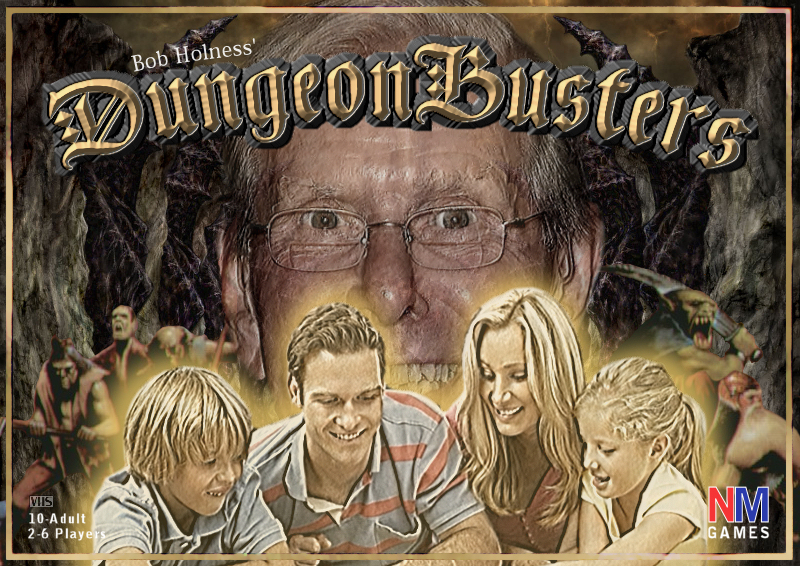
Today in Nostalgia Corner we look at Bob Holness’ DungeonBusters, the unlikely collision of populist television gameshow and high-concept video-enhanced boardgame.

Christmas morning, 1993. I am sitting cross-legged on my living room floor. My hands – unusually clean of jam and frogspawn – grapple with a hefty, rattling present. I can’t believe it. It is. It very probably is. I savour this sweet, wonderful moment and replay the television advert that has held my young, gormless mind captive for weeks. Heavy in its rotation and brutal in its allure, it’s there, screen-burned onto the inside of my eyelids.

A near-black screen, fuzzed with rural analogue interference. The sounds of ghostly winds blow across four empty seconds. Then, rising – gently rising, the noise of battle. Clattering shield and sword. Wild screams. Snapping, arcing lightning bolts. As it peaks, and the wood veneer shell of the TV set hums and sings in sympathy, Bob’s face fades in. Disembodied. Eerie. He hangs there, impassive and staring from the pregnant screen, saying nothing. Saying everything. A coarse yell lunges out from the fray, overruling the invisible mob by decibels and driving the single, waspy speaker into distortion –
“M!” it roars, reverb-heavy, “EHHHHHHHHMMM!”
Silence and black again, out of which looms the stone and gold logotype. The sound of a slamming portcullis. End.

Easy to learn yet difficult to master, DungeonBusters (or DB as it’s known to the diehards) was the game that separated the boys from the men. It then separated those boys into increasingly small sub-groups of boys until it found the ones who didn’t like different coloured foods touching eachother on their plates. A ludicrously complicated rule-set, seven twenty-six sided dice, a chaotically shifting modular board of ‘necrexagons’ and the ever-present, harrowing face of Bob judging your every move all combine to make a game of DB an arduous but ultimately rewarding ordeal. The rules of play are similar to those of many games in the table-top/board stable, but the efforts of the developers to shoehorn in elements from TV’s Blockbusters result in turn-cycles that average an hour at least. A typical short turn usually occurs as follows:
Check> Declare bonus> Roll for movement> Check> Call letter> Roll defend> Roll damage/Save letter>  Answer> Roll bonus> Attack> Cast spell (if saved letters = +6 and are valid)> Roll path reveal> Query> Shift board> Check> Roll cover advantage> Trade/pilfer> Roll heal/Cast heal if saved letters = +5 and are valid> Check> Praise Bob> End turn.
Overall, this game is a fine one, and my memories of it are fond. Of course, nobody I knew could bear to play it with me, so most campaigns were played against myself using a variety of voices and hats. Yes, just me, Old Bob and those long afternoons in a dimly-lit room. I imagine though, that getting around this initially daunting board with a couple of friends similarly interested in high fantasy, general knowledge and tightly regimented rule-structures would be a delight. Its beautifully cast miniatures, its superbly printed and illustrated ‘Buster’s Guide and its detailed, moody tiles and cards each do an admirable job of drawing a tenacious player into the world and keeping them there. For advanced DBers, an expansion set – The Gold Run – was released a year later, adding new character classes, higher-level spells and two-hundred additional question cards to the base game.
My only gripe with DungeonBusters is that Bob’s involvement is misleadingly overstated in both the advertising and box design. Though you are instructed to always have the supplied videotape running, his presence contributes little to the game aside from a sort of imperious menace. In fact, Bob neither speaks nor moves significantly throughout the entire three-and-a-half-hours and instead just glares from the TV whilst breathing heavily. To his credit, he doesn’t even blink. Not once. Absolute solid beast. Sometimes I used to wonder what he was thinking, or if he was lonely too.

Would recommend.

Stay dangerous,

OXO

0

Nostalgia Corner – Return to Drear

Drear3

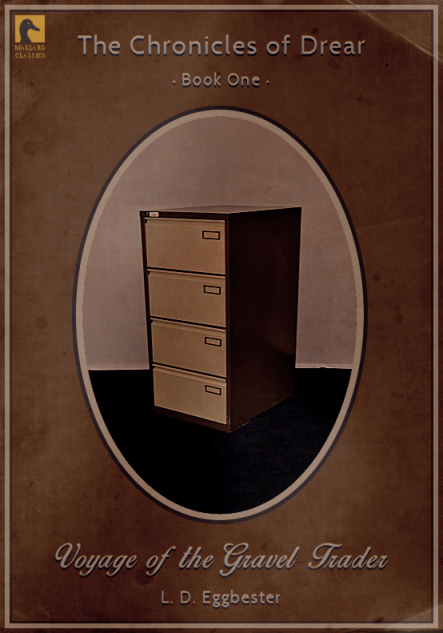
Today in Nostalgia Corner we look at Voyage of the Gravel Trader, the first book in the well-known Chronicles of Drear series. Like many, I grew up with these novels just lying around; originally owned by my elder sister, they were passed – by way of my two brothers – down to me. The lasting memory I have of this book is one of sitting halfway up the stairs in my parents’ house, locating my place before carefully resolving the folded page corner, then being swept up and away to another place for hours at a time before eventually touching down once again in a world which seemed newly brighter. The image above is a scan of the late 80’s paperback I found under a bush in 2004, as sadly my original 1955 edition could not be salvaged after passing briefly through Scamp, who was both the Brown family dog and the brown family dog.

I like to think that the greatest stories come to you as broken things, requiring the reader to pause periodically and use their wits to, as it were, experimentally push the bits around until the devices mesh their teeth and spring into whirring life. At the end of such novels, it’s almost as if you’re standing side-by-side with the author at a workbench, knuckles pleasantly grazed and wiping grease from your fingertips as they polish their glasses. You shake hands, nod your respects and go your separate ways. Voyage of the Gravel Trader however, is not such a book. Its author, Lawrence Damocles Eggbester, is in fact mercilessly straightforward in his storytelling, allowing no room whatsoever for subtextual interpretation and showing next to no courtesy to the reader’s imagination. Indeed, upon the release of the recent movie tie-in edition, Matthew Pounder of The Ardent on Sunday remarked, “Only the most dismal of masochists would subject themselves to this toss…Eggbester’s works, though unquestionably impressive in terms of sheer world-building scope, nevertheless read like a Haynes manual.” It is an unavoidable truth: Eggbester’s themes, scenes and characters have all the emotional warmth and humanity of the Drearian Quarrylands which he so anally describes over twenty-eight punishing pages. This rare talent makes him a truly unique author, and for that I salute him.

The story, being the first of the thirty-four-book chronicles, sets the stage for the entire series by relating the beginning of all the comings and goings between the worlds that would follow. It concerns mainly the three popular but thick Brellend children: Georgina, Jeremy and Andrew who are whisked away from wartime Sussex by means of a mysterious beige filing cabinet and deposited in the workaday land of Drear. Once there, they are tasked by the ancient Boardking Clive – as he sits dying on his thronechair – with bringing an end to the epic and bitter trade negotiations which have for centuries blighted a realm whose economy is almost entirely dependant upon its principal export: gravel and gravel-like aggregates. Despite their protestations they are press ganged aboard the mighty cargo vessel The Gravel Trader bound for international waters, where they spend several months heroically petitioning and placating representatives of the surrounding nations in the hope that they may lift their cruel embargoes, thereby allowing Drear and its people to once again enjoy relative economic stability. The children are assisted in this strange new world by their guide Mr. Nicholas – a half man, half man normal man with no quirks and few distinguishing features. Over the course of their long, long adventure they learn the true value and inherent nobility of things like bribery, brown-nosing, manipulation and under-the-table dealing.

Below is a short extract from the book, and one of my favourite passages. It is reproduced here with the kind permission of Susan Eggbester and Mallard Publishing. I have taken something of a liberty by omitting the large sections of material which deal primarily with descriptions of the surroundings, as these accounted for the vast majority of the chapter and would be far too unwieldy in this format. I would also like to add that this book is very much of its time and as such describes attitudes to gender which are, to modern eyes, quite unacceptable. I have left these parts of the text intact for posterity.


Chapter 7

In the Hall of the Boardking

As they were bustled through the tall, polished, mahogany doors, Georgina eyed the back of the leading guardclerk’s shining silver waistcoat with interest. I should like a gown of that fabric, she thought to herself, as she was just a silly girl with a head full of dresses and gay songs. To either side of her, her brothers strode manfully in the fashion of their father but their faces betrayed them with shadows of nervousness. Andrew turned sharply to the retreating guardclerk who had been flanking him and spoke hotly, pushing his chest out ever further. ‘Now see here! I demand-‘
‘Demand?’ A voice cut him dead, thin but made grand by the echoing expanse of the hall. ‘What is it you demand, boy?’ Their guards silently brought the doors together behind them and their footsteps died away, a solemn tattoo in the then aching quiet. The children looked about themselves in a confused moment before finding the voice’s owner seated in an enormous, imposing chair silhouetted against the vast window that made up a good deal of the furthest wall.
‘Well, I…’ began Andrew again, though this time uncertainty and the magnificence of his surroundings cooled his tone. ‘That is, I mean…’ He lapsed into silence. Jeremy gave him an encouraging glance, but to no result.
‘Hmm,’ said the voice. ‘I expect you merely wish to ask why it is you have been bought here, yes?’ The voice came softer now. Kinder, or perhaps simply more weary. ‘Do come closer so I can look at you, my eyes are not what they once were.’
It was Georgina who stepped first, as she had less worry of the situation, being just a silly girl with a head full of flowers and kittens. Always protective of their sister, the boys quickly overtook her and presently they were all three of them standing before the largest desk any of them had ever seen. It was as wide as a barge and of the same rich, dark wood as the doors. The man behind it regarded them wordlessly, looking from one to the next as if studying dogs for ticks. He appeared elderly and frail and sharp and keen all at once.

Months before, during the summer holidays Jeremy had been digging for worms in the herb garden and found what turned out to be a very old bone needle. He had held it up to the sun, turning it this way and that, and was taken by its near-translucent quality. The man before them, with the curve of his nose and pale, pale skin put in him mind of that fine, delicate prize. Andrew was transfixed only by this stranger’s gaze; there was something in it – some urging thing which made one want to be found good, productive. He’d seen its like before in a magazine from the front lines, on some general or other, highly decorated. Do well, it said. I want you to do well. Andrew felt a small part of himself deep, deep down answer involuntarily: Yes. I will do well. Georgina thought he looked stern like her headmaster but did think his tie was a pretty colour.
Apparently satisfied, the man behind the mammoth desk snapped his eyes down to one of a number of yellow paper sheets arrayed before him. ‘Now, it says here…’ he intoned, ‘yes, it says you all arrived via the File Cabinet. Is that correct?’
Both Andrew and Georgina nodded and uttered that yes, they had indeed come by that strange piece of office furniture, but Jeremy could never long contain his curiosity and it bubbled to the surface as he blurted out, ‘I say, it must be some jolly queer magic of yours to have fetched us here all the way from England!’ He thought for a moment as he looked from the man to his siblings, then added, ‘Wherever here is.’
‘Magic!’ exclaimed the man. ‘My dear child, there is no magic in this world nor any other. Your manner of travel was nothing more than hard science – logistical matter facsimile technology we used in days gone by, before the shipping unions got their way. The File Cabinet simply made an account of your component parts then destroyed the originals after creating duplicates here. Here being Drear, of course.’
‘Drear,’ echoed Jeremy and Andrew hollowly. Georgina however, though she was just a silly girl with a head full of ponies and dolls, had heard something which did not altogether please her. ‘Destroyed?’ she murmured.
The man winked at her. ‘Oh yes. Smashed to atoms in the blink of an eye. PAFF!’ He spread his slender fingers in the air and waved them to illustrate his point.
‘So you mean to say we’re… dead?‘ quavered Georgina, peering down at her small hands and beginning to sob as she looked, mystified, from one palm to the other.
‘No no no, not dead as such,’ said the man hastily. ‘These new bodies you have are just as good as those you had in England, and you’re still you, are you not?’
‘I… I think so. I don’t know,’ she replied in a tiny voice, moving to hug herself to Jeremy who did not look completely well but held her close regardless, shaking ever so slightly as he did so.
‘There’s a good girl. Now, before I forget, you must take these,’ said the man, removing three thick, blue document folders from a drawer to his left and placing one in front of each of the children. ‘While it is true you are still, legally speaking, you, it is also the case that you are physically made of Drearian material. This means you are regretfully, but technically, the property of the Drearian State. Do not concern yourselves overly with this, it is merely a formality and almost never an issue. Though if you wish to query or appeal against our ownership you need only fill out these forms in triplicate and return them, in person, to our any of our legalknights.’
All this suddenly became too much to bear for Andrew, and once again the colour rose in his cheeks as he declared, ‘This sounds entirely like a very rum business indeed, and I for one don’t like it one bit! Our father will hear of this, you mark my words, and I think it’s only right to tell you that our family has the services of the finest legal minds in the British Empire!’
‘Ah,’ nodded the man gravely while glancing at his sheets, ‘Andrew. I’m afraid the lawyers you speak of have no sway here, and in any case, they would make poor sport for the Drearian legalknight battalions. If you doubt this then please do look out from my window upon the Great Car Park.’
Andrew snorted petulantly as he loped over to the indicated pane and, after a moment, gasped at what he beheld. A Great Car Park indeed. An oblong courtyard with three walled sides stretching what must have been a clear mile toward the grey horizon, and upon every square foot of it stood stiffly a legalknight. Rank after rank, row after row, thousand after thousand they stood; their burnished bronze briefcases gleaming in what little sunlight slunk through the cloud-thick skies. ‘They’re… impressive,’ he admitted, unable to keep the awe from his throat.
‘Yes, they are. Impressive one and all,’ sighed the man, his apparent weariness returning, ‘but not a man among them is able to save us. We need something they do not possess – something no Drearian possesses.’
A gloom had crept into the hall then, a pervading sense of glory lost. The children shuffled uncomfortably as their host’s attention seemed to wander away. ‘Well. This won’t do,’ said the man, the Boardking abruptly, clapping his aged palms together and dispelling the bad air. ‘Let us talk of hope and brighter things. Tell me children, what know you of gravel?’


About the Author

Lawrence Damocles Eggbester (1917-1988) was born into a middle-class family in Brighton, England. He was educated at the St Dingus School for Boys and latterly Townton University where he studied bookkeeping and geology. At the age of twenty-three, having narrowly avoided conscription due to an acutely gammy forehead, Eggbester went to work as a file clerk for Dunworthy Aggregates, Dover – a post he held for the majority of his working life. It was there he first met his wife, Georgina. Prior to the Drear series of books he wrote three non-fiction titles in his spare time: Gravel: A Treatise, Gravel: A Deeper Understanding and the much more lighthearted Gravel Games for Rational Youths.
There are several unsubstantiated claims regarding Eggbester’s inspiration for The Chronicles of Drear. The most widely-spread of which is that one cold day in December 1954, after a morning spent staring blankly at the hundreds of files crowding his desk, he suffered some sort of colossal breakdown and ran yelping from the company’s offices. Some sources claim he was found by police later that week in a local library – unshaven, dishevelled and hurriedly shoving copies of C.S. Lewis’ recently published Narnia series down the front of his trousers. This sequence of events has been vehemently denied by family members who uniformly describe him as being “a quiet, sober man and a pillar of the community.”

Stay dangerous,

OXO

0

The Quickening

There will be only some.

There will be only some.

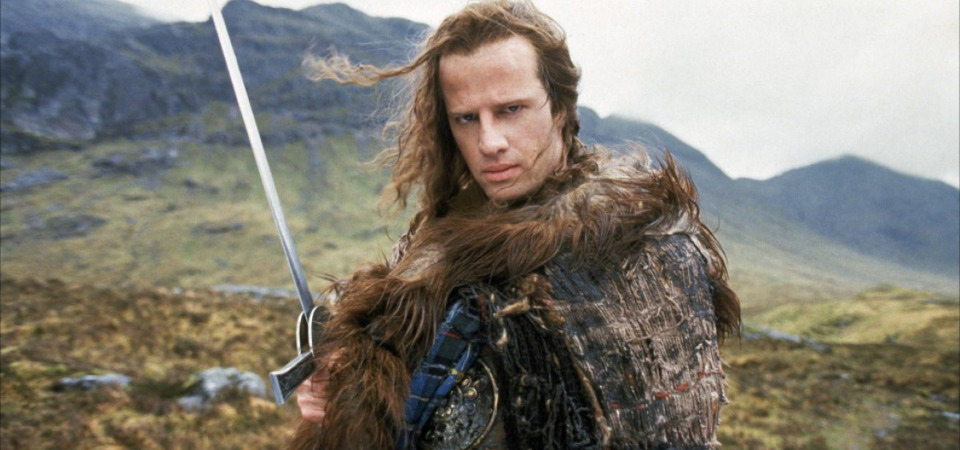
It’s back! Yes! Yes it is! And much like the sequel to the fantastic Highlander, it’ll be visually similar yet ultimately disappointing. I’ve been very busy during the last few months – there have been a lot of good things on television. Anyway, my main point is that I’ll be posting new comics again, but only semi-regularly.
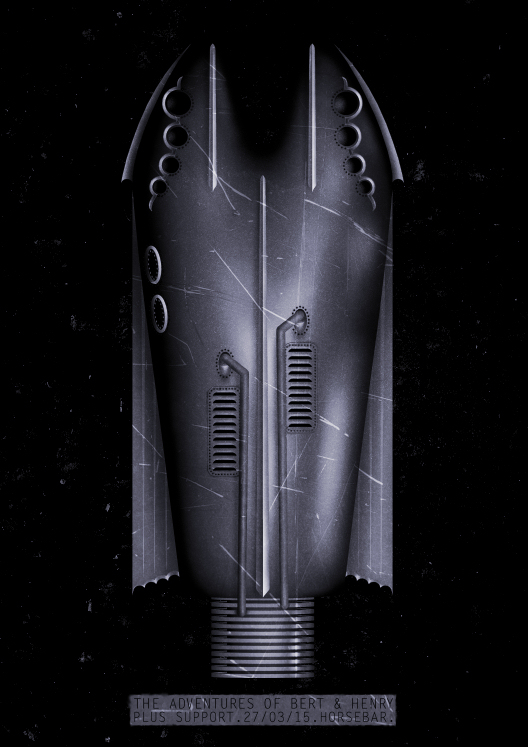
Also, here’s a pretty neat cover I did for The Adventures of Bert and Henry’s new CD. Get your face to their Facebook page and find a couple of freebie belters off of it there. Incidentally, if you’ve got a copy of their CD and the words on the back part of it (opposite to the front, the one with less picture and more word) led you here: well done. Give yourself a pat on the forehead. As a bonus to you, you can enter the secret Easter Egg text hidden there into the ‘Blog Search’ field of this site to receive absolutely fuck all.

Scream at your parents until they buy it for you.

Scream at your parents until they buy it for you.

Also also, they’re making a sweet video for one of their tracks. I drew a spaceship that might be in it, and some other stuff. Here’s a concept for a poster using that ship. Ha! It looks a bit like a wang. Ha! Ha ha ha!

It looks a bit like a wang.

It looks a bit like a wang.

Stay adventurous.
OXO

Something Weird

Here’s something weird – this isn’t me:

WhoTheHell

Why would Violet (her name is Violet) choose that particular unlikely car-crash of words? Why?

Stay curious.

OXO